
These five lakes are popular Colorado ice fishing spots. But how well-documented is their freeze timing, really? We dug into outfitter reports, news coverage, and municipal data for each one. Some lakes have solid, years-long records. Others have just one good season of notes. Here's what the data actually shows, lake by lake.
Ice Fishing Data
5 Well-Known Colorado Ice Fishing Lakes — What the Data Actually Shows
By IceCast Safety Team · Updated August 13, 2026
⚠️ WARNING:Freeze dates below are historical patterns, not predictions for this season. Ice conditions vary every year and across a single lake. ALWAYS verify ice locally before any activity — drill test holes, check clarity, talk to locals. No historical data can guarantee current safety.
Why Elevation Isn't the Whole Story
It's easy to assume higher elevation means earlier ice. That's only part of the picture. Depth, wind exposure, and moving water flowing into a lake matter just as much.
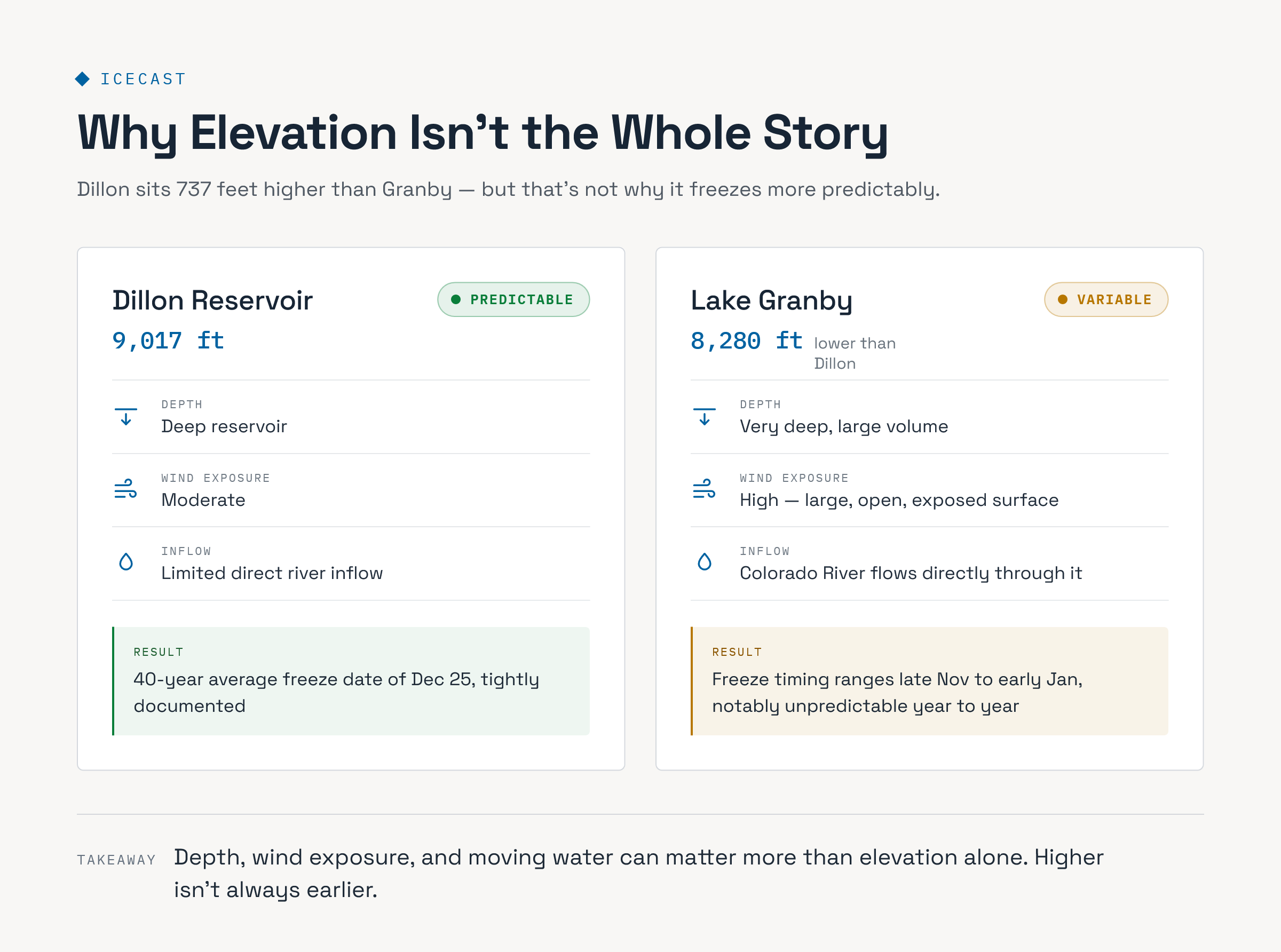
Dillon Reservoir sits at 9,017 feet and has one of the most reliable, well-documented freeze patterns of any lake in this list. Lake Granby sits lower, at 8,280 feet, but its freeze timing is far less predictable — because the Colorado River flows through it, and it sees more wind exposure.
Never assume a lake is frozen based on elevation alone.
5 Colorado Lakes, Ranked by Elevation
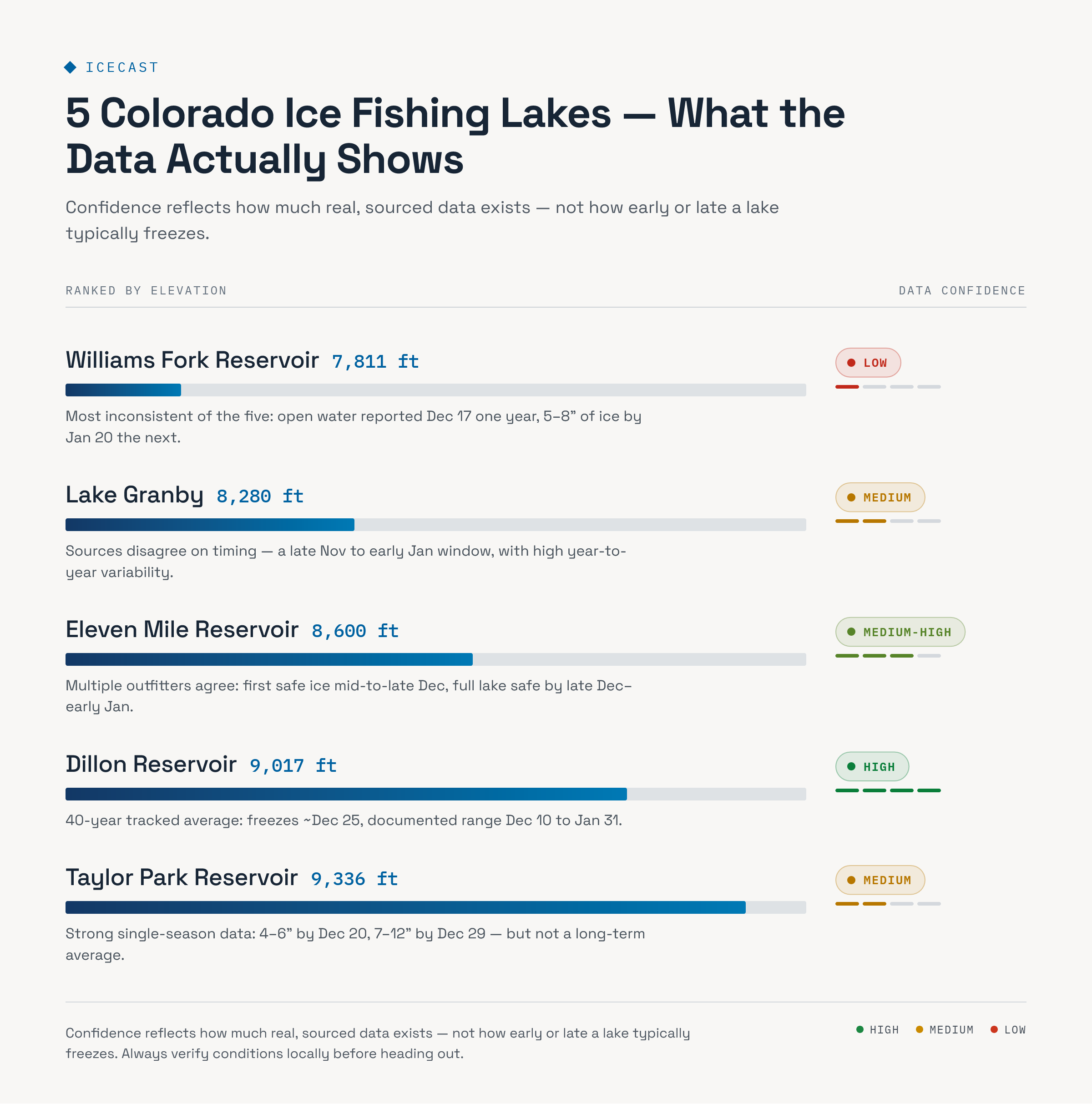
The "confidence level" in this chart doesn't mean how early or late a lake freezes. It means how much real, sourced data we could find about that lake's freeze timing. A lake can freeze reliably every year and still have a low confidence rating — simply because nobody has tracked it closely.
Lake Granby (8,280 ft)
Confidence: Medium
Sources disagree on the exact timing. Freeze-up generally falls somewhere between late November and early January, with a lot of variation from year to year. In 2015, unusually high water levels pushed the freeze notably later than normal.
Source: local outfitter reports (Destination Granby, Fishing With Bernie), CBS Colorado news coverage.
Dillon Reservoir (9,017 ft)
Confidence: High— the strongest data of all five lakes.
Dillon has a 40-year tracked average freeze date of December 25. The documented range runs from as early as December 10 to as late as January 31.
Source: Denver Water / Summit County Sheriff's Office, reported by Summit Daily News.
Taylor Park Reservoir (9,336 ft)
Confidence: Medium
Taylor Park has one strong single-season data point: 4 to 6 inches of ice by December 20, 2023, growing to 7 to 12 inches by December 29, 2023. That's a well-documented snapshot, not a long-term average.
Source: IceFishColorado guide reports.
Williams Fork Reservoir (7,811 ft)
Confidence: Low— the most inconsistent of the five.
One report showed open water on December 17. Another, from the following year, showed 5 to 8 inches of ice by January 20. Williams Fork is a genuine example of how unpredictable freeze timing can be, even at a single lake.
Source: Fishing With Bernie outfitter reports.
Eleven Mile Reservoir (8,600 ft)
Confidence: Medium-High
Multiple outfitter and marina sources agree here: first safe ice usually shows up mid-to-late December, with the full lake typically safe by late December to early January.
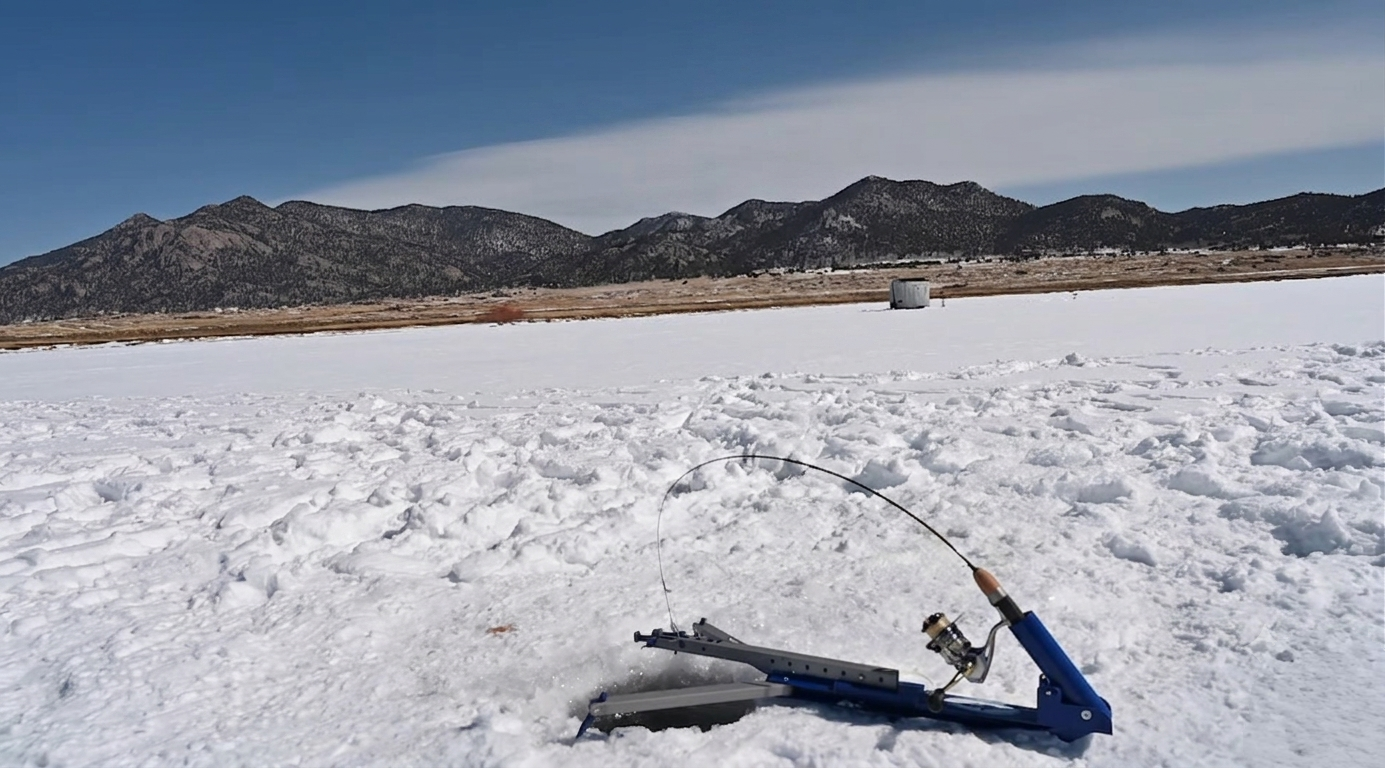
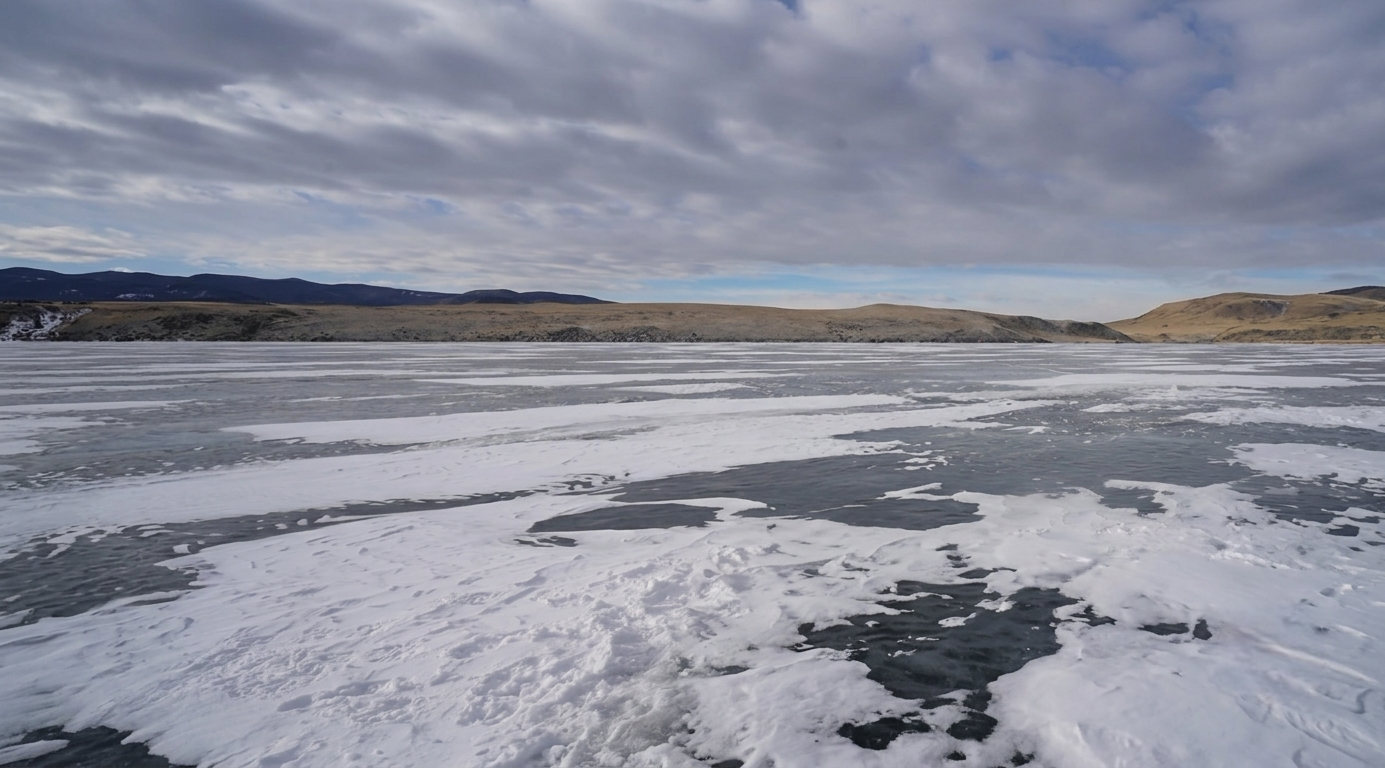
Source: IceFishColorado, 11 Mile Marina weekly reports.
Even well-documented lakes vary season to season — see our video on Eleven Mile's 2024-25 vs 2025-26 seasons for a real example.
The Real Takeaway
Even with real research across multiple sources, only Dillon Reservoir has genuine multi-year climatological data. Most lakes only have single-season snapshots or reports that disagree with each other.
That's exactly why real-time, current-season reporting matters more than historical averages. Historical patterns can only tell you what's typical — not what's happening on the lake right now.
IceCast is built to close that gap. Join the waitlist to get early access, or see our data and methodology to learn how we approach ice reporting.
For more on ice thickness basics, read How Thick Does Ice Need to Be to Walk On? and our Ice Thickness Safety Chart.
Frequently Asked Questions
Which Colorado lake has the most reliable freeze-date data?
Dillon Reservoir, with a 40-year tracked average freeze date of December 25.
Does higher elevation mean a lake freezes earlier?
Not reliably. Depth, wind, and inflow matter too — Dillon freezes more predictably than the lower-elevation Lake Granby.
When does Lake Granby usually freeze?
Sometime between late November and early January, and it varies a lot from year to year.
Is Eleven Mile Reservoir predictable?
More consistent than most Colorado lakes, but it still varies season to season.
Why don't all lakes have historical freeze data?
No centralized tracking system exists for most Colorado lakes. CPW doesn't publish a climatological ice-on database, so only Dillon has dedicated municipal tracking.
DISCLAIMER:IceCast provides educational information only. Historical freeze patterns do not predict current-season ice conditions. We make no guarantee of accuracy for any lake's timing. Always follow guidance from Colorado Parks & Wildlife and the National Weather Service. See our Terms of Service for full details.
Author: IceCast Safety Team · Last updated: August 13, 2026. Sources: Colorado Parks & Wildlife, National Weather Service, Denver Water / Summit Daily News, and outfitter reports from Destination Granby, Fishing With Bernie, IceFishColorado, and 11 Mile Marina.